

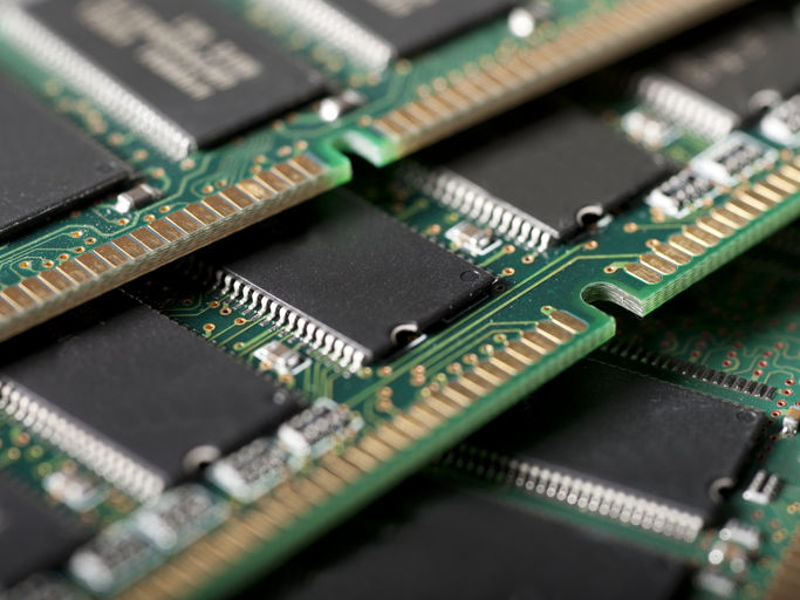
Dynamic random-access memory (DRAM) contract prices are on the rise. AI clusters and high-density virtualization, together with data-heavy applications, are consuming bandwidth faster than legacy fabrics can supply. Supply is tightening, and high bandwidth memory (HBM) production is drawing capacity away from standard dual in-line memory modules (DIMMs).
At the same time, operators report underutilized central processing units (CPUs) and graphics processing units (GPUs) because data cannot move through the network fast enough to keep compute fed. When performance drops, many organizations default to buying more memory. But is this really the answer?
This article explores why DRAM volatility results in weaker return on investment (ROI) for memory expansion, particularly when the underlying limit is not memory-related. We look at the hidden bottleneck of network underperformance, the role of original equipment manufacturer (OEM)-equivalent optics and interoperability, and how ProLabs offers fast, certified fiber that beats costly memory upgrades.
DRAM Prices Climb While ROI Falls
Last year, Q1 alone saw a 20% QoQ increase, driven by AI demand and restricted supply. The global DRAM module market achieved $13.3BN revenue in 2024, a 7% YoY increase that reversed the 28% decline in 2023. AI systems, especially large-scale training clusters, are reshaping how DRAM capacity is allocated in the semiconductor industry:
- AI accelerators rely heavily on HBM, which absorbs more of the industry’s manufacturing capacity and diverts wafers away from standard server DRAM. This shift means operators are competing for fewer modules at higher prices, at a time when budgets are already stretched.
- Long lead times for packaging and substrate capacity are caused by bottlenecked manufacturing steps. Leading AI accelerators rely on advanced packaging techniques that prioritize HBM over commodity DIMMs. Even if a supplier increases wafer output, packaging throughput often cannot keep up.
- AI server growth is absorbing a disproportionate share of DRAM, using more memory per node compared with general-purpose servers. Hyperscalers are buying more DRAM per server, even as HBM consumes upstream capacity.
The result is unpredictable price swings and tight supply. Fewer wafer starts are dedicated to traditional DRAM, even though data center demand for DIMMs remains strong. This shift lifts contract pricing and contributes to today’s market volatility. As HBM becomes a larger share of the memory market, standard DRAM becomes more expensive to produce relative to its return, tipping the balance of what vendors choose to manufacture. The downstream impact runs far wider, affecting supply and pricing across the entire data center ecosystem. Yet the pressure does not end with memory.
Storage Pricing Pressures Add to the Squeeze
NAND flash pricing is also increasing. Analysts predict spending to rise from $21.1BN in 2025 to $22.2BN in 2026, an approximate 5% rise. Solid-state drive (SSD) vendors are signaling further price pressure as fabs rebalance production lines toward higher-value products. Hard disk drive (HDD) availability is also shifting, influenced by consolidation in the sector and mounting demand for nearline capacity.
This component inflation affects the entire supply chain. When both DRAM and storage price points are elevated, performance upgrades are an escalating expense. To overcome this challenge, the focus must shift from reliance on price-sensitive components, toward the layer of the stack that is restricting utilization.
When The Network Becomes the Real Bottleneck
Across real-world deployments, network capacity restricts performance. East-west traffic is growing, causing workloads to hit network limits before compute or memory saturation. According to recent reports, only 7% of AI/ML teams report GPU utilization above 85% during peak workloads, with the majority experiencing lower utilization due to data loading, network, or I/O delays. The constraint isn’t the hardware itself, but the movement of data between nodes, storage, and accelerators.
Bandwidth and latency shape how efficiently workloads run. Although AI training, virtualized databases, analytics clusters, and multitenant environments behave differently, they share a common dependency on timely data movement. When the network cannot keep pace with demand, adding DRAM has minimal impact. Instead of feeding CPUs and GPUs faster, the system waits for data to arrive.
Yet many organizations still buy memory to fix the wrong problem. The issue is a network designed for an earlier generation of traffic patterns. Without addressing this, memory expansion increases cost without improving real throughput. A more effective path comes from strengthening the network itself.
Fiber Expansion Delivers Stronger ROI
Fiber upgrades deliver measurable performance gains at a fraction of the cost of bulk DRAM expansion. High-bandwidth optics increase workload throughput across clusters in environments limited by east-west congestion, reducing queue delays while supporting reliable latency. These improvements drive CPU and GPU utilization, yielding far larger gains than additional memory.
A further advantage is that optic pricing remains stable throughout DRAM and NAND volatility, due to mature manufacturing and predictable demand cycles. With fewer application stalls and better performance from existing hardware, upgrading fiber is often the fastest and most cost-effective path to increasing output.
High-Performance Optics Without the OEM Premium
ProLabs supports operators who want stronger performance without the cost associated with OEM-branded optics. With a portfolio of products ranging from sub-100G through 1.6T, we help organizations scale their network at the pace of their workloads. Customers save up to 70% with interoperable optics built to match OEM performance requirements. Our products undergo rigorous testing to ensure compatibility with switches, routers, and server network interface cards (NICs) across mixed environments. This assurance is critical for operators who need dependable behavior across legacy and next-generation platforms.
ProLabs also applies higher qualification standards than low-cost generics. Full-code verification, stress testing, extended temperature validation, and ongoing interoperability testing all help support long-term reliability.
The result is a path to network scaling that avoids OEM premiums and the risks associated with low-quality optics. Operators improve bandwidth and reduce cost, keeping upgrades aligned with capacity needs.
The Smarter Path to Performance Gains
DRAM prices will continue rising as AI adoption and HBM demand influence supply. Storage costs show similar behavior, reinforcing a pattern of volatility across the component market. Yet many data centers still assume memory is the easy fix for performance problems, leading to upgrades that deliver limited return.
The solution lies in addressing network saturation. Raising fiber capacity boosts throughput, strengthens utilization, and supports future compute cycles without relying on unpredictable component pricing. With a fiber-first approach, operators can scale efficiently and get more years out of their current hardware.
Go Fiber First for Higher Impact
Before investing in DRAM, consider how fiber upgrades improve performance and lower cost. Explore ProLabs high-speed optical solutions and contact us about the best upgrade path for your environment.
